Model Structure#
This page describes the structure of OSeMOSYS Global and the naming conventions used. This is a helpful resource for when modifying the configuration file or interpreting the results.
Reference Energy System#
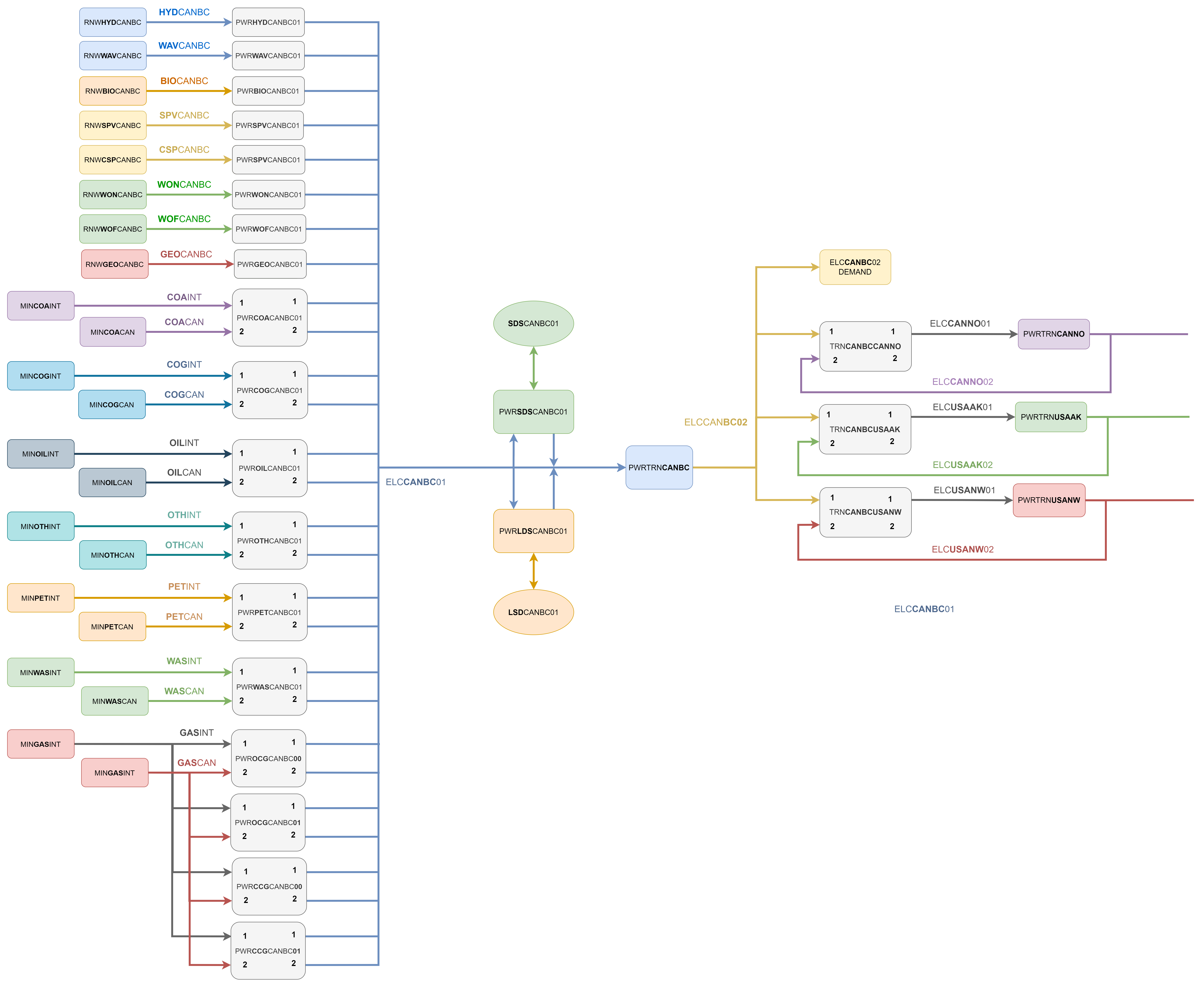
The schematic below shows a (very) high level overview of the reference energy system (RES). OSeMOSYS models are built through connecting commodities (ie. fuels) and energy conversion technologies. In OSeMOSYS Global, each technology and commodity has a unique identifier based on it purpose (mining, transmission, ect…), its type (hydropower, solar power, ect…), and/or its location (country and regional node).

See also
A full RES for a single OSeMOSYS Global node can be found here. See OSeMOSYS’ documentation for more information on Reference Energy Systems.
Spatial Codes#
Each node in OSeMOSYS Global is given a unique 5 letter long code. It has the format of XXXYY, where XXX is the country code and YY is the region code.
Country Code#
OSeMOSYS Global natively models up to 163 countries. All countries are described using their three letter ISO code which can be found here. A few examples are given in the table below
Country |
Code |
|---|---|
Netherlands |
NLD |
Canada |
CAN |
India |
IND |
Regional Node Codes#
Some countries are further divided into regional nodes, for a total of 265 nodes. If a country does not have subregions, 2 XX characters to the end of the country codes.
Character Example |
Location |
Length |
Description |
|---|---|---|---|
X X X _ _ |
(01-03) |
5 |
Country Code |
_ _ _ X X |
(04-05) |
5 |
Regional Node Code |
Examples of regional node codes are given below:
Country |
Node |
Code |
|---|---|---|
United States |
California |
USACA |
Canada |
British Columbia |
CANBC |
Bangladesh |
n/a |
BGDXX |
Acronyms#
Each unique technology and commodity in OSeMOSYS Global has a three-character code used to identify it. These three letter codes are not directly modelled, instead they are used to build the full technologies and commodity codes used in OSeMOSYS Global.
Technology Acronyms#
Thirteen power generation technologies are modelled in OSeMOSYS Global. The acronyms used to identify each technology are given below.
Technology |
Code |
|---|---|
Biomass |
BIO |
Combined Cycle Natural Gas |
CCG |
Coal |
COA |
Cogeneration |
COG |
Concentrated Solar Power |
CSP |
Geothermal |
GEO |
Hydroelectric |
HYD |
Open Cycle Natural Gas |
OCG |
Oil |
OIL |
Other |
OTH |
Petroleum |
PET |
Solar Photovoltaic |
SPV |
Nuclear |
URN |
Wave |
WAV |
Waste |
WAS |
Offshore Wind |
WOF |
Onshore Wind |
WON |
Commodity Acronyms#
Each of the power generation technologies operate on a given commodity, which are listed in the table below. Note, that some technologies share commodities, such as combined cycle natural gas and open cycle natural gas both operating on the commodity GAS.
Commodity |
Code |
|---|---|
Biomass |
BIO |
Natural Gas |
GAS |
Coal |
COA |
Geothermal |
GEO |
Hydro |
HYD |
Oil |
OIL |
Other |
OTH |
Petroleum |
PET |
Solar |
SPV |
Nuclear |
URN |
Wave |
WAV |
Waste |
WAS |
Offshore Wind |
WOF |
Onshore Wind |
WON |
Technology Codes#
Technologies are responsible for converting one energy carrier into another. Each technology can have unique parameters, such as costs, efficiencies, and capacity/generation limits. There are four types of technologies in OSeMOSYS Global; mining technologies, power generation technologies, transmission technologies, and trade technologies.
Mining Technology Codes#
Mining technologies are responsible for introducing raw commodities into the model. These technologies are either 9 or 11 characters long, depending on the type of resource the technology mines. Technologies that introduce non-tradable commodities into the model are 11 characters long, while technologies that introduce tradable commodities are 9 letters long. The difference comes from renewable resources being tracked at a nodal level, while physical resources being tracked at a country level.
Character Example |
Location |
Length |
Description |
|---|---|---|---|
M I N _ _ _ _ _ _ _ _ |
(01-03) |
11 |
Mining tradable commodity |
R N W _ _ _ _ _ _ |
(01-03) |
9 |
Mining non-tradable (renewable) commodity |
_ _ _ X X X _ _ _ ( _ _ ) |
(04-06) |
9 / 11 |
Technology code |
_ _ _ _ _ _ X X X ( _ _ ) |
(07-09) |
9 / 11 |
Country code for domestic or |
R N W _ _ _ _ _ _ X X |
(10-11) |
11 |
Regional node code |
Examples of mining technologies are given in the table below
Code |
Description |
|---|---|
MINGASCAN |
Mine gas in Canada |
MINGASINT |
Import gas from international markets |
RNWWONCANBC |
Mine onshore wind in British Columbia, Canada |
Power Generation Technology Codes#
Power generation technologies are responsible for converting raw commodities into electricity transmission commodities. These technologies are 13 characters long and include spatial and technology identifiers. The makeup of these codes are given in the table below.
Character Example |
Location |
Length |
Description |
|---|---|---|---|
P W R _ _ _ _ _ _ _ _ _ _ |
(01-03) |
13 |
Power generator |
_ _ _ X X X _ _ _ _ _ _ _ |
(04-06) |
13 |
Technology code |
_ _ _ _ _ _ X X X _ _ _ _ |
(07-09) |
13 |
Country code |
_ _ _ _ _ _ _ _ _ X X _ _ |
(10-11) |
13 |
Regional node code |
_ _ _ _ _ _ _ _ _ _ _ 0 0 |
(12-13) |
13 |
Technology that can not be invested in |
_ _ _ _ _ _ _ _ _ _ _ 0 1 |
(12-13) |
13 |
Technology that can be invested in |
All power generation technologies will at minimum be represented with a 01 at the end of the code, signifying the technology can be invested in (if the total max capacity limits allow it). Only some technologies are represented by a second code that end with a 00. These will represent historical technologies that exist at the start of the model but can no longer be invested in, such as thermal generators built a number of years ago with poor efficiencies.
Examples of power generation technologies are given in the table below
Code |
Description |
|---|---|
PWRHYDCANBC01 |
Hydro power plant in British Columbia, Canada |
PWROCGINDNE00 |
Open cycle gas power plant in North East, India, that can not be invested in |
PWRSPVUSACA01 |
Solar power plant in California, USA |
Transmission Aggregator Technology Codes#
Transmission aggregator technologies are responsible for converting transmission electricity into end use electricity, and receiving traded electricity. It acts as a dummy aggregation technology. The makeup of this code is given in the table below.
Character Example |
Location |
Length |
Description |
|---|---|---|---|
P W R _ _ _ _ _ _ _ _ |
(01-03) |
11 |
Power generator |
_ _ _ T R N _ _ _ _ _ |
(04-06) |
11 |
Transmission technology |
_ _ _ _ _ _ X X X _ _ |
(07-09) |
11 |
Country code |
_ _ _ _ _ _ _ _ _ X X |
(10-11) |
11 |
Regional node code |
Example transmission technologies are given below.
Code |
Description |
|---|---|
PWRTRNCANBC |
Transmission in British Columbia, Canada |
PWRTRNINDNE |
Transmission in North East, India |
PWRTRNUSACA |
Transmission in California, USA |
Electricity Trading Technology Codes#
Electricity trading technologies are responsible for trading electricity between nodes. Physical commodity trading codes are discussed later. Trading technologies connect one nodes endiuse electricity to an adjacent nodes transmission aggregator technology. The table below summarizes the codes.
Character Example |
Location |
Length |
Description |
|---|---|---|---|
T R N _ _ _ _ _ _ _ _ _ _ |
(01-03) |
13 |
Transmission technology |
_ _ _ X X X _ _ _ _ _ _ _ |
(04-06) |
13 |
Country to trade from |
_ _ _ _ _ _ X X _ _ _ _ _ |
(07-09) |
13 |
Regional node to trade from |
_ _ _ _ _ _ _ _ X X X _ _ |
(10-11) |
13 |
Country to trade to |
_ _ _ _ _ _ _ _ _ _ _ X X |
(12-13) |
13 |
Regional node to trade to |
Example transmission technologies are given below.
Code |
Description |
|---|---|
TRNCANBCCANNO |
Transmission between Canada (CAN) British Columbia (BC) and Canada (CAN) North (NO) |
TRNCANBCUSAAK |
Transmission between Canada (CAN) British Columbia (BC) and United States (USA) Alaska (AK) |
TRNCANBCUSANW |
Transmission between Canada (CAN) British Columbia (BC) and United States (USA) North West (NW) |
Warning
Trading technology codes must be alphabetical based on country codes. For example, trade between the USA and Canada will always TRNCANxxUSAxx
Storage Technology Codes#
Each storage object is comprised of two components; a capacity constrained technology compoenent and an energy constrained store component. The capacity constrained technologies operate on node transmission level electricity (ie. before the aggregator). Only generic Long Duration Storage (LDS) and Short Duration Storage (SDS) are available to be modelled. Naming conventions for the storage capacity technologies is given below.
Character Example |
Location |
Length |
Description |
|---|---|---|---|
P W R _ _ _ _ _ _ _ _ _ _ |
(01-03) |
13 |
Power generator |
_ _ _ L D S _ _ _ _ _ _ _ |
(04-06) |
13 |
Long duration storage |
_ _ _ S D S _ _ _ _ _ _ _ |
(04-06) |
13 |
Short durantion storage |
_ _ _ _ _ _ X X X _ _ _ _ |
(07-09) |
13 |
Country code |
_ _ _ _ _ _ _ _ _ X X _ _ |
(10-11) |
13 |
Regional node code |
_ _ _ _ _ _ _ _ _ _ _ 0 1 |
(12-13) |
13 |
Investable technology |
Attached to each storage technology is a storage unit which is responsible for inter-termporal energy shifting. The naming convention for these energy constrained storage units is given below.
Character Example |
Location |
Length |
Description |
|---|---|---|---|
S D S _ _ _ _ _ _ _ |
(01-03) |
11 |
Short Duration Storage |
L D S _ _ _ _ _ _ _ |
(01-03) |
11 |
Long Duration Storage |
_ _ _ X X X _ _ _ _ |
(04-06) |
11 |
Country code |
_ _ _ _ _ _ X X _ _ |
(07-09) |
11 |
Node code |
_ _ _ _ _ _ _ _ 0 1 |
(09-11) |
11 |
Investable Technology |
The graphic below gives an example of how short duration and long duration storage is integrated into a OSeMOSYS Global model of British Columbia, Canada.

Commodity Codes#
Commodities (or fuels) carry energy and flow into and out of technologies in OSeMOSYS. There are three classifications of commodities in OSeMOSYS Global, primary fuel, transmission level fuel, and end use fuel. These are graphically shown below.

Primary Fuel Codes#
Primary fuels in OSeMOSYS Global can be six or eight characters long. Depending on the fuels purpose, the country and/or region may or may not need to be tracked.
Character Example |
Location |
Length |
Description |
|---|---|---|---|
X X X _ _ _ _ _ |
(01-03) |
6 / 8 |
Commodity code |
_ _ _ X X X ( _ _ ) |
(04-06) |
6 / 8 |
Country code for domestic or |
_ _ _ _ _ _ X X |
(07-08) |
8 |
Regional node code |
Examples of primary fuels are given below
Code |
Description |
|---|---|
GASINT |
Internationally mined gas |
GASCAN |
Gas from domestic mining in Canada |
WONCANBC |
Onshore wind fuel from mining in British Columbia, Canada |
Transmission Fuel Codes#
Transmission level fuels will carry energy from the primary power generation technologies to the transmission technologies. All transmission level fuels follow the same 10 character naming convention.
Character Example |
Location |
Length |
Description |
|---|---|---|---|
E L C _ _ _ _ _ _ _ |
(01-03) |
10 |
Electricity |
_ _ _ X X X _ _ _ _ |
(04-06) |
10 |
Country code |
_ _ _ _ _ _ X X _ _ |
(07-08) |
10 |
Regional node code |
_ _ _ _ _ _ _ _ 0 1 |
(09-10) |
10 |
Transmission Level |
Examples of transmission fuels are given below
Code |
Description |
|---|---|
ELCCANBC01 |
Transmission electricity in British Columbia, Canada |
ELCINDNE01 |
Transmission electricity in North East, India |
ELCBGDXX01 |
Transmission electricity in Bangladesh |
End Use Fuel Codes#
End use fuels will carry energy from the transmission technology to energy demands or trading technologies. All end use fuels follow the same 10 character naming convention.
Character Example |
Location |
Length |
Description |
|---|---|---|---|
E L C _ _ _ _ _ _ _ |
(01-03) |
10 |
Electricity |
_ _ _ X X X _ _ _ _ |
(04-06) |
10 |
Country code |
_ _ _ _ _ _ X X _ _ |
(07-08) |
10 |
Regional node code |
_ _ _ _ _ _ _ _ 0 2 |
(09-10) |
10 |
End Use |
Examples of end use fuels are given below
Code |
Description |
|---|---|
ELCCANBC02 |
End use electricity in British Columbia, Canada |
ELCINDNE02 |
End use electricity in North East, India |
ELCBGDXX02 |
End use electricity in Bangladesh |
Commodity Trading#
This section will provide further detail on how commodity trading functions in OSeMOSYS Global.
Primary Fuel Trading#
Two primary fuel types exist in OSeMOSYS Global; fuel that can and fuel that can not be traded. Primary fuel that can not be traded may be due to it being a natural resource (such as wind and solar). Fuel that can be traded include physical goods (such as coal and uranium). The table below summarizes which primary fuels are tradable.
Commodity |
Tradable |
|---|---|
Biomass |
No |
Natural Gas |
Yes |
Coal |
Yes |
Geothermal |
No |
Hydro |
No |
Oil |
Yes |
Other |
Yes |
Petroleum |
Yes |
Solar |
No |
Nuclear |
Yes |
Wave |
No |
Waste |
No |
Offshore Wind |
No |
Onshore Wind |
No |
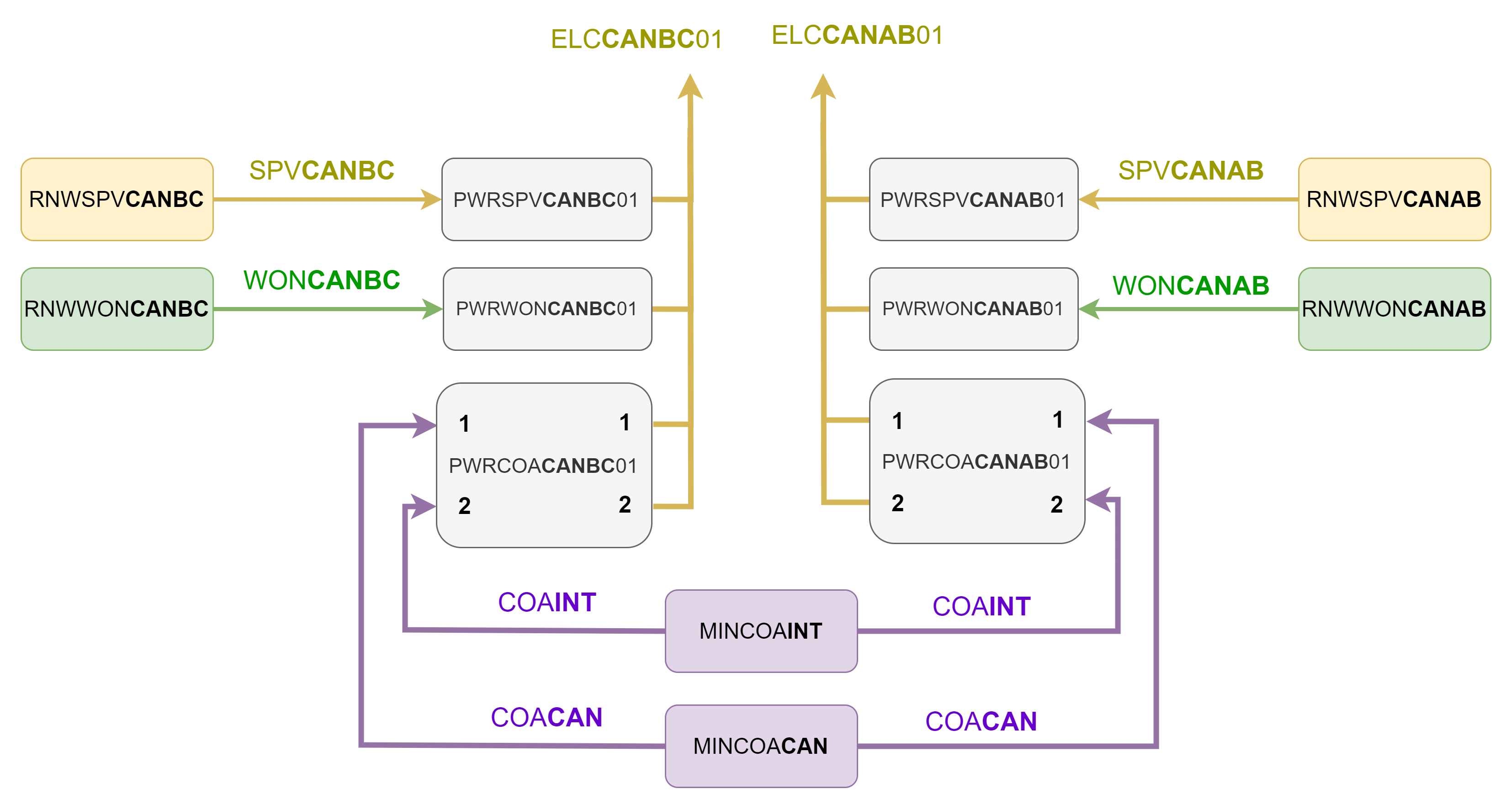
Fuel which can not be traded is mined by nodal mining technologies and flows directly into its respective nodal power generator; for example, wind and solar resources. Fuel which can be traded is mined at a country level and flows into any node within the country. Alternatively, tradable fules can be bought on the global market for a premium.
End Use Fuel Trading#
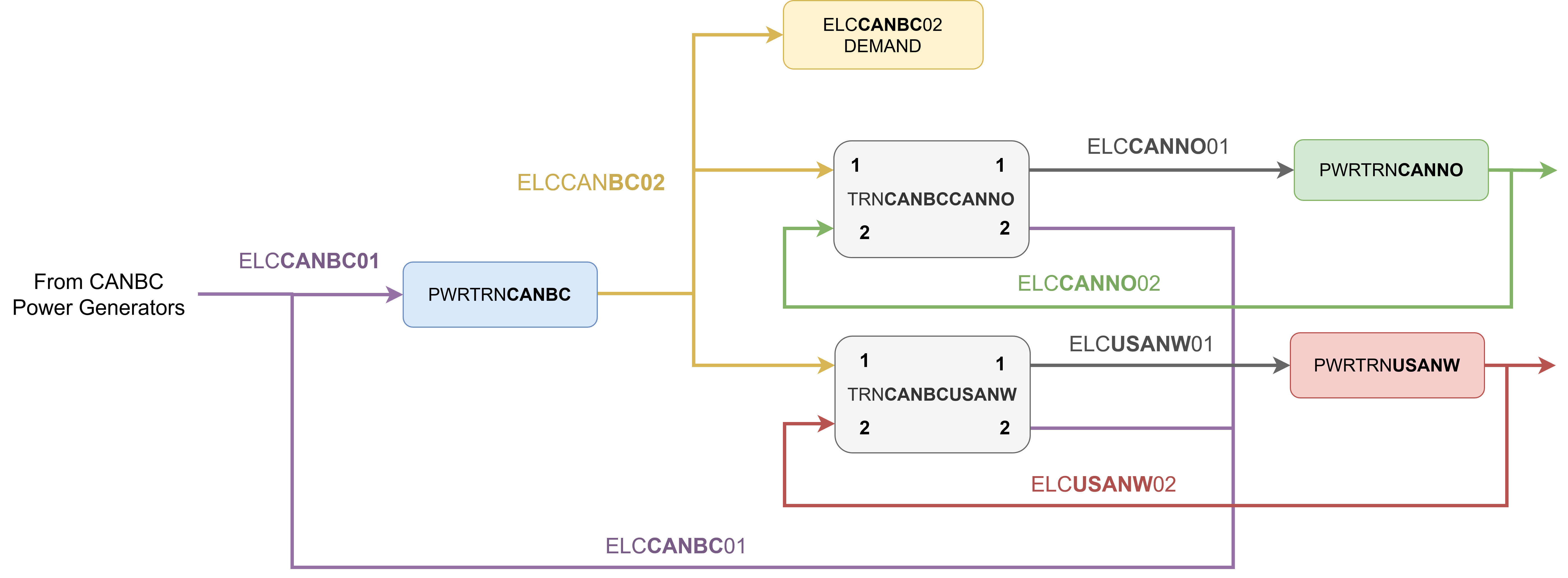
Much like with primary fuels, end use fuels can also be traded. However, end use fuel can only be traded to adjacent nodes, rather then on the international market and regions abroad. End use fuel trading is managed through designated electrical trading technologies. An example of how end use trading works is shown below for British Columbia, Canada, and two of its adjacent regions, the North West, USA and Alberta / North West Territories, Canada.
Full Example#
The schematic below shows the full reference energy system for the node of British Columbia, Canada. All nodes in OSeMOSYS Global follow the same structure. While all technologies exest in each node, depending on input parameters (which can be configured by the user), constraints may be enforced that do not allow certain technologies to be used and/or invested in.